Economic Security at the WTO: What the Record Shows

First findings from the Economic Security Dashboard
WTO Members have not agreed on what economic security means or when it can be invoked. And yet, they are discussing security-related measures across WTO bodies. The Economic Security Dashboard maps those discussions so they can be read together.

Framing economic security
Governments have always restricted trade for reasons other than commercial policy. What has changed is the volume and the vocabulary. As the WTO’s World Trade Report observed, security concerns are no longer confined to armed conflict but reach into the far broader notion of economic security (WTO, 2023).
There is no agreed definition of the term ‘economic security’ and Members use the term alongside national security, resilience, strategic autonomy, de-risking and economic coercion, often in the same intervention and not always about the same measure. One Member has categorically stated that there are problems in international trade that “the WTO cannot address, including: imbalances; overcapacity and overconcentration of production; economic security; and supply chain resilience”.
"Economic security has become the centre of trade policies of several trade partners and blocs. It has also become the justification for a number of unilateral trade practices and policies, on the export and import sites to reduce trade dependencies, reassure production capacities, and diversify domestic production, address overcapacity, and overconcentration concerns." Switzerland, General Council meeting, 6-7 May 2026, WT/GC/M/224
The Dashboard does not attempt to define what economic security is. It records how participants frame it. The underlying dataset relies on three anchors in creating inclusion rules: the legal anchor is GATT Article XXI and its interpretation in dispute settlement reports; the economic anchor is the World Trade Report 2023, which treats economic security as resilience, the capacity to absorb and recover from adverse shocks; and the policy anchor is the EU’s Joint Communication on a European Economic Security Strategy and its four risk categories (European Commission, 2023). From those anchors follow five sub-domains (Table 1).
An intervention enters one only where the intervention itself connects the measure to security, resilience, strategic autonomy or coercion. A subsidy, local content rule or trade remedy does not qualify merely because it matters economically.
Table 1: Economic security sub-domains
Sub-domain | What it captures |
Sanctions | Sanctions, embargoes and trade bans, and their defence under the WTO security exceptions. Coercion claims sit here where the instrument is a sanction. |
Export Controls | Licensing and restrictions on dual-use goods, advanced technology and strategic products, including entity listings and end-user or re-export controls. |
Supply Chains | Access to critical minerals, rare earths, energy and other essential inputs, and measures to reduce fragility through diversification, stockpiling or relocation. |
Security Tariffs | Tariffs outside normal MFN rules justified by national security, reciprocity or trade imbalance, and responses framed as coercion or tariff weaponization. |
Strategic Autonomy | Production support, local content, procurement, investment screening, overcapacity and non-market practices where a security rationale is present. |
How is the discussion evolving at the WTO?
The first release identifies 133 interventions from 23 documents circulated between 1 January and 15 August 2026, involving 27 participants across seven WTO bodies.
Two bodies carry most of the traffic. The Council for Trade in Goods accounts for 47 interventions and the General Council for 46, together about 70% of the dataset. The remaining 30% is spread across the Committee on Market Access (20), the SCM Committee (14), the TBT Committee (4), TRIMS (1) and the TRIPS Council with its technology transfer working group (1). Economic security is no longer confined to the political bodies.
Participation is concentrated. China (19), the United States (16), the European Union (14), Venezuela (11) and the Russian Federation (10) intervene most often. The counts should be read as a measure of who spoke on the record, not of whose economy is most exposed.
Members are overwhelmingly registering objections. Apprehensions account for 78 interventions, followed by defence or explanation (31), general statements (14) and proposals (10).
Figure 1: Interventions by WTO body and by participant, according to the stance taken

A single intervention can cover more than one sub-domain, and the current version records up to two, giving 220 sub-domain entries across the 133 interventions. The discussion is heavily oriented towards strategic autonomy (35%) and supply chains (27%). Sanctions (15%), export controls (12%) and security tariffs (11%) are raised less often.
Figure 2: Share of the discussion held by each sub-domain

Measure ownership is similarly concentrated. Of the 133 interventions, 55 concern a measure attributed to the United States or China. A further 35 identify no specific measure and are interventions about the direction of the system rather than about a particular instrument.
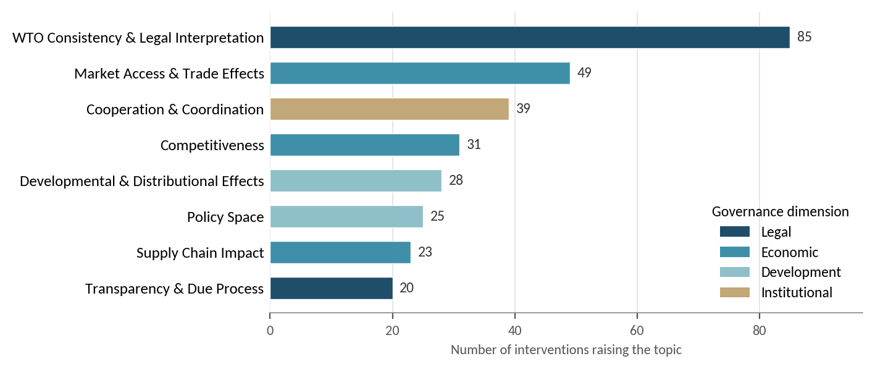
Each intervention is also coded for the governance questions it raises. Legal considerations appear in 101 interventions and economic considerations in 95, followed by development (51) and institutional (39). At topic level, WTO consistency and legal interpretation dominates, appearing in 85 interventions.
Figure 3: Governance topics raised, grouped by governance dimension
Emerging patterns from the first release
The patterns below become visible when interventions are read across bodies and across measures.
1. Overcapacity, reframed as a dependency problem
Overcapacity appeared in 21 interventions across four bodies.
The United Kingdom described a self-perpetuating cycle running from distortive subsidies towards unilateral measures and fragmentation. The European Union called it a structural distortion spilling into high-tech and green transition sectors and creating dependence risk, with developing economies bearing the brunt. The United States described the model as generating strategic dependency in critical sectors, and Canada stressed the effect on developing countries’ industrial capacity and supply chain diversification, among others. In each case the measure recorded is not a subsidy programme but state-driven industrial overcapacity itself, with governance topics running to supply chains and competitiveness rather than to the SCM Agreement alone.[1]
China, on the other hand, contested both the label and the venue. It rejected overcapacity as a politicized term, argued that its competitiveness reflects productivity, scale and supply chain resilience rather than subsidies, characterized the tariffs of certain Members as using the market as a weapon to sever supply chains, and stated that the SCM Committee had no legal basis to discuss overcapacity at all. Under a separate agenda item tabled by China on the level playing field, the United States defended its CHIPS Act guardrails and the golden share in U.S. Steel as national security arrangements.[2]
In the General Council, Korea called for collective restraint against tariff increases used to respond to overcapacity, warning of ‘triggering repeated and reciprocal responses from Members’; the United States rejected it as too inflexible a response to these distortions.[3] In the Council for Trade in Goods and also in the Committee on Safeguards, Canada cited global excess capacity from non-market policies to justify a steel derivative surtax imposed outside the Agreement on Safeguards.[4]
Read across the four bodies, an industrial policy dispute is being restated as a dependency and security dispute, with no agreement on which committee is entitled to hear it.
2. Economic security at the reform table
Seven Members and groups have placed economic security in the WTO reform discussions, and they are asking for different things.
The European Union proposes that the system integrate economic security considerations the rulebook does not currently foresee, and raises a review of the MFN exceptions and sectoral plurilaterals.[5] The United States proposes an authoritative interpretation of Article XXI confirming that each Member self-judges its essential security interests and that adjudicators will not review the invocation.[6] China argues that abuse of the security exceptions is eroding the system, and calls for development-centred reform with restored dispute settlement.[7] The United Kingdom asks for a modernized enforcement toolbox against overcapacity and overconcentration.[8]
Developing Members are raising the exception itself, not only its effects. The African Group submitted that expanding use of heightened tariffs, a broad resurgence of industrial policy, and security measures by major economies has opened a gap between Members with strategic leverage and those without.[9] Colombia states that the use of the security exception by large players is more consequential than developing countries’ use of special and differential treatment.[10] In the e-commerce work programme, Colombia argues for expanding the Article XX and XXI justifications so that Members can respond to dependency and security interests.[11]
3. Familiar instruments, new rationales
Economic security is entering the WTO through rules that already exist, rather than through a separate security agenda.
The United States defended its GATT paragraph 3 shipbuilding exemption on economic security grounds, citing Chinese targeting of the maritime, logistics and shipbuilding sectors. China, Korea and the EU responded on competition and market access terms.[12] The Russian Federation is contesting the EU’s Article XXVIII substantial interest calculations and steel tariff rate quota redistribution, arguing that sanctions should not determine quota shares.[13] It has also challenged the EU Deforestation Regulation’s country risk methodology, because the existence of EU sanctions automatically places a country in the high-risk category.[14]
The pattern repeats in the technical committees. China’s Cryptography and Cybersecurity Laws are argued in the TBT Committee.[15] The EU’s Net-Zero Industry Act, as implemented by Italy’s FER X Decree, is challenged in the Committee on Market Access and defended as open strategic autonomy.[16] Japan’s Economic Security Promotion Act appears in a subsidy notification reply.[17] India raises export controls on semiconductors and rare earths in a draft Ministerial Declaration on technology transfer.[18]
Read one committee at a time, each intervention looks like a discrete trade concern. Read together, they show security rationales moving through the existing machinery of the WTO.
Using the Dashboard
These interventions sit in different WTO documents and different committees and are difficult to read together. The Dashboard brings them into one place.
For each intervention it records the document, date, body, participant, paragraph reference, stance, the measures at issue and their owner, the security sub-domains, the governance dimensions and topics, and a neutral summary. It helps show which Members appear as both challengers and defenders, whether a measure is raised differently in different bodies, how a delegation’s framing changes between meetings, and which measures are raised repeatedly without a proposal.
The Dashboard maps how Members frame issues. It does not assess whether a security justification is well founded, or what any measure did. Coverage is phased and compiled on a best-efforts basis: minutes circulate long after the meetings they record, and absence from the dataset is not evidence that an issue was not discussed. Counts record how often something was raised, not how much it mattered.
The Economic Security Dashboard is available at https://www.tradelawobservatory.com/dashboards
References
[1] G/SCM/M/135, Item 9.
[2] G/SCM/M/135, Item 9 and 11.
[3] WT/GC/285; WT/GC/M/224, Item 8.
[4] G/C/W/891; G/SG/352.
[5] WT/GC/REFORM/W/6; WT/GC/W/986.
[6] WT/GC/W/998.
[7] WT/GC/W/989.
[8] WT/GC/W/993; WT/GC/REFORM/W/4.
[9] WT/GC/W/992.
[10] WT/GC/M/223, paras. 8.32–8.33.
[11] WT/GC/WPEC/M/25.
[12] WT/GC/M/222, paras. 34.4–34.32.
[13] G/C/M/153, paras. 10.106–10.110; G/MA/M/85, Item 16.
[14] G/C/M/153, paras. 10.501–10.502; G/MA/M/85, Item 25.
[15] G/TBT/M/98, Items 2.4.8–2.4.9.
[16] G/MA/M/85, Item 17.
[17] G/SCM/Q2/JPN/91.
[18] IP/C/W/729/Rev.1.

Comments